
Three instruments, one method
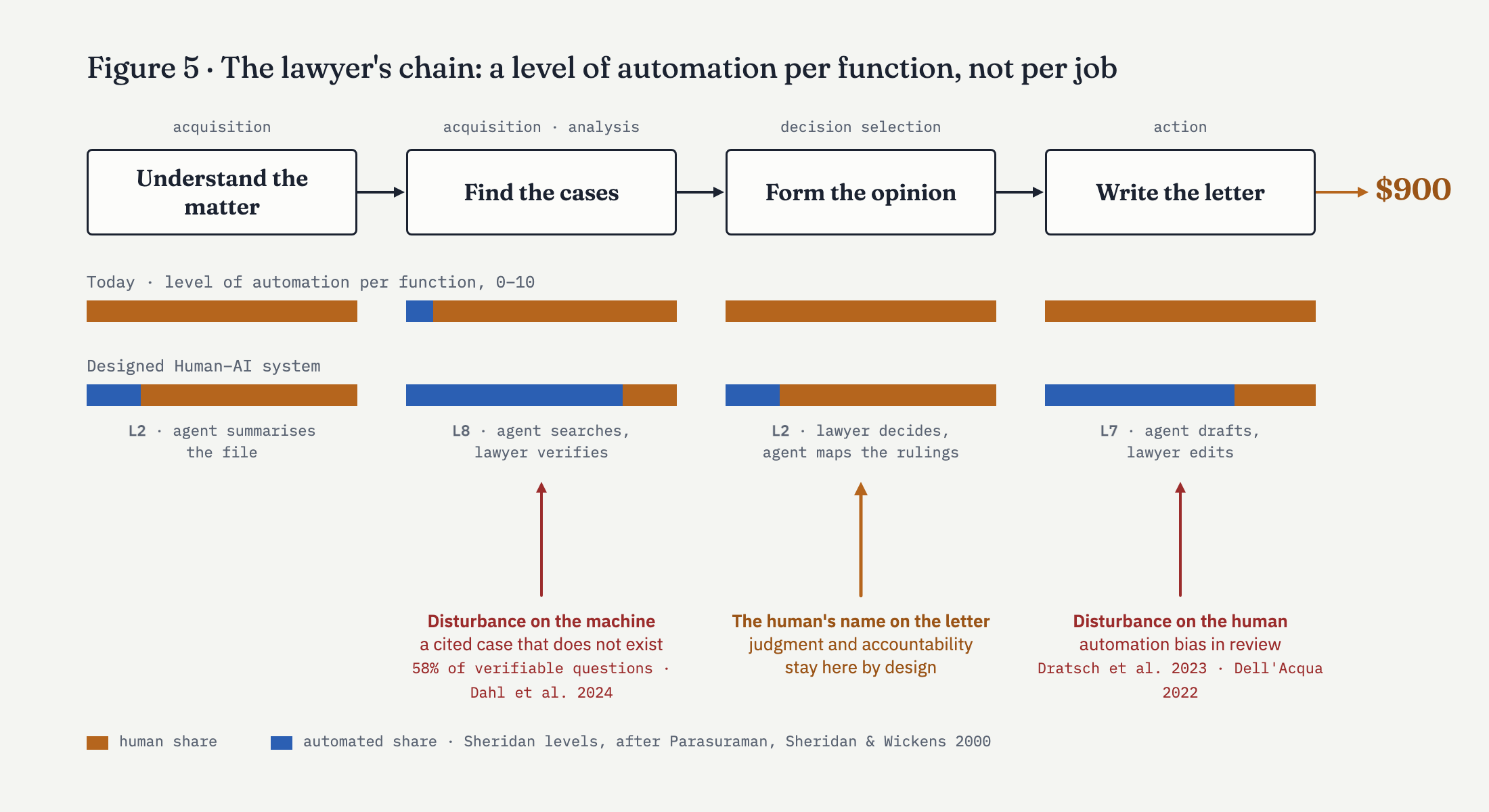
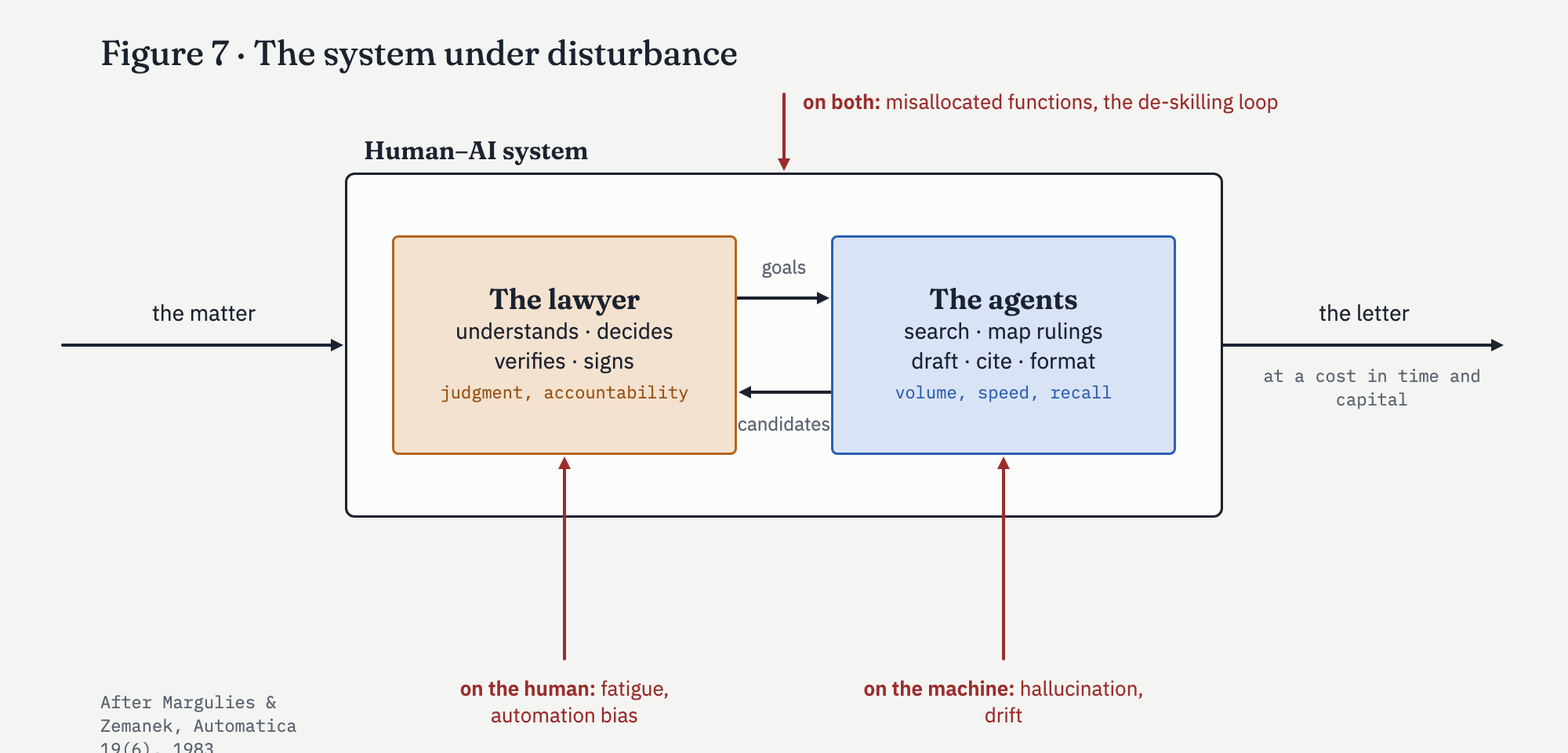
Every job is a chain of functions; every Human–AI system runs under disturbances; every disturbance needs a catch that is a kept, practised, paid human function. The agenda is to make that design method rigorous enough to deploy and measurable enough to falsify.
A method for knowledge work that starts from the chaîne opératoire of a real job, sets a level of automation per function — never per job — names the disturbance each function is exposed to, and assigns the catch. Re-solved as the frontier moves. The method lives in unglamorous material: the user experience of verification, the integration points where an agent hands work back to a human, the staffing and pricing patterns a firm adopts with the allocation.
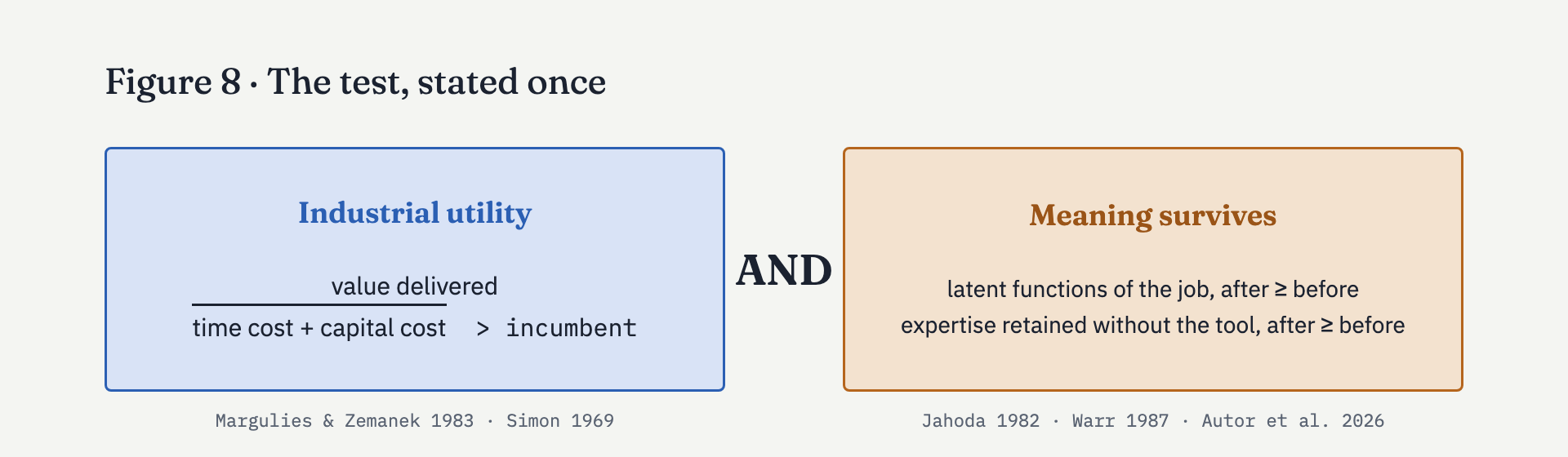
Protocols that put Jahoda's five latent functions of work and Warr's nine environmental features on the same scorecard as output per unit of time and capital — measured before and after deployment, so both sides of the Kayraxis test are read from the same data. A system that raises output while stripping the job of shared purpose, status or skill use fails, and the scorecard shows it failing.
Records of where the human intervened, what they caught, and how long they practised each function — so the de-skilling loop that Bainbridge described in 1983 can be seen closing before it closes, and verification can be proven to be a real, exercised function rather than a disclaimer.
Committed numbers, stated so they can be wrong
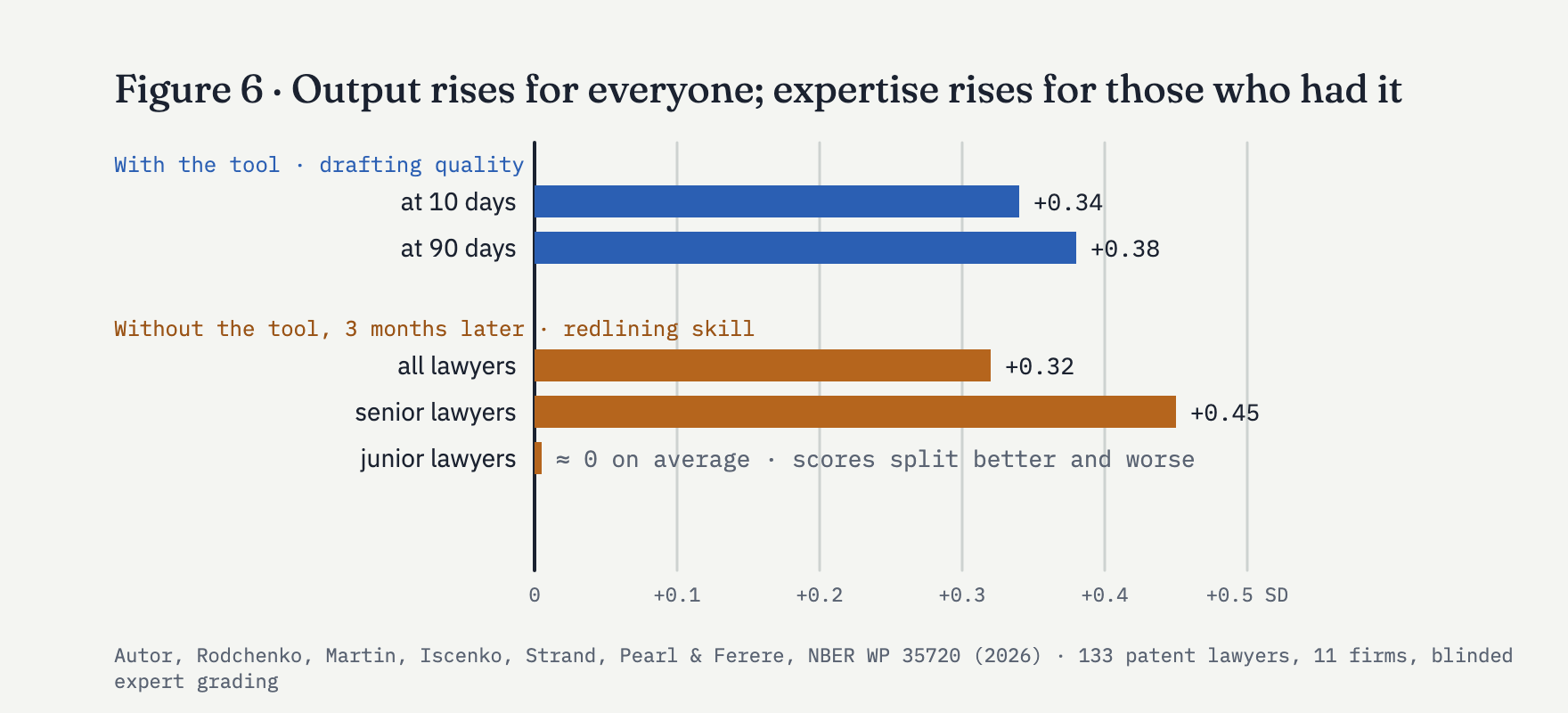
We run field trials in the manner of Autor et al. and Dell'Acqua et al. — inside real deployments, measuring both the output while the tool is on and the expertise that remains when it is off. We publish what we find, including when it argues against us.
For the first system, the opinion letter: delivery in a day instead of a week, at a third of today's cost, with every citation passing a kept, practised human verification — and the professional's latent-function scores, measured before and after, no lower than they were. The dream scenario is Autor's 2026 result inverted: juniors who work inside the system redline better cold after three months, because verification was built as their path to expertise instead of being removed from it.
And what would prove us wrong: juniors inside a system built on kept verification still showing no retained gain; verification that cannot be priced into the work without losing the cost case; or Vaccaro, Almaatouq and Malone's finding — that human–AI teams lose to the better partner on decision tasks — surviving even allocation per function. Any one of these breaks the programme's operational content.
The questions we want company on
- The price of the catch. Can kept, practised human verification be priced into professional work without losing the cost case against the incumbent — and if so, under which billing structures?
- Autor inverted. Does the junior's retained-expertise gap close when verification is designed as the path to seniority rather than removed from it? This is the central empirical bet of the programme.
- Designed complementarity on decisions. The meta-analytic record says human–AI teams lose to the better partner on decision tasks. Does allocation per function — automation high in acquisition and action, low in decision selection — beat that record, or does the finding survive?
- The fragile functions. Which of the latent functions of work — time structure, shared experience, collective purpose, status, required activity — degrade first under reorganisation, and which design patterns protect them at least cost?
If you are a firm willing to host a trial, a researcher who wants to instrument one, or a critic who can find the flaw in the test — the manifesto is the starting prompt, and this page is the door.
Who is doing this

Tural Gulmammadov
Founder · Kayraxis — Founder & CEO · Mergen AI
Tural has been building AI/ML systems professionally since 2015. Before founding Mergen AI and Kayraxis, he was Head of Core Generative AI Development at Oracle, leading cross-functional teams of data scientists and AI/ML engineers responsible for production-grade generative AI platforms deployed across multiple industries.
He designed and taught an AI/ML Operations course in the joint program between the Vector Institute and the University of Toronto, holds a USPTO patent on graph-based discrete optimization, authored A Practical Guide to Oracle AI Engineering (2026), and was a technical reviewer of Graph Machine Learning. His technical interests sit where this programme's method does: graph theory, discrete mathematics and probabilistic reasoning applied to machine learning systems under real-world constraints. Before any of that, there were chess boards and programming olympiads in Baku.
The argument in its engineering form
The programme's operational ideas grew out of a series of essays on how Human–AI systems should be wired. The manifesto's sources, tagged by position, carry the scholarly lineage.