Work must survive
the transition.

Work is not only an economic activity. It is a human category. The use of intellect and tools against the obstacles nature puts in front of us is what turned the toolmaking animal into a human being.
I build AI systems for a living — agents that read regulations, draft documents and execute work a professional used to bill hours for. Because of that, people sometimes assume I belong to one of the two camps that dominate the public debate: the one racing to automate everything, and the one that wants to compensate everyone for its disappearance. I don't. This manifesto is my attempt to describe a third position — not a compromise between the other two, but a different claim about what work is.
If we treat work as something to be replaced, and then compensate people for its absence, we risk losing more than income. We lose the process through which humans have always understood themselves, cooperated, and built society.
Three pitfalls I am deliberately trying to avoid in what follows:
- Doomerism. The risks of this transition are real — Chapter IV measures some of them — but fear recruits nobody for long. This is, in the end, an optimistic document: it argues that the transition can be designed, and it shows the instruments.
- Post-work utopianism. I will not argue that work is a burden to automate away and compensate with a transfer. Chapter II lays out fifty years of evidence that compensation replaces exactly one of the six things a job provides — and that people who lose the other five get sick.
- Productivity boosterism. I will also not argue that AI is simply a tool that makes everyone faster. A tool that reaches judgment reorganises the job around itself, and "faster" says nothing about what survives the reorganisation.
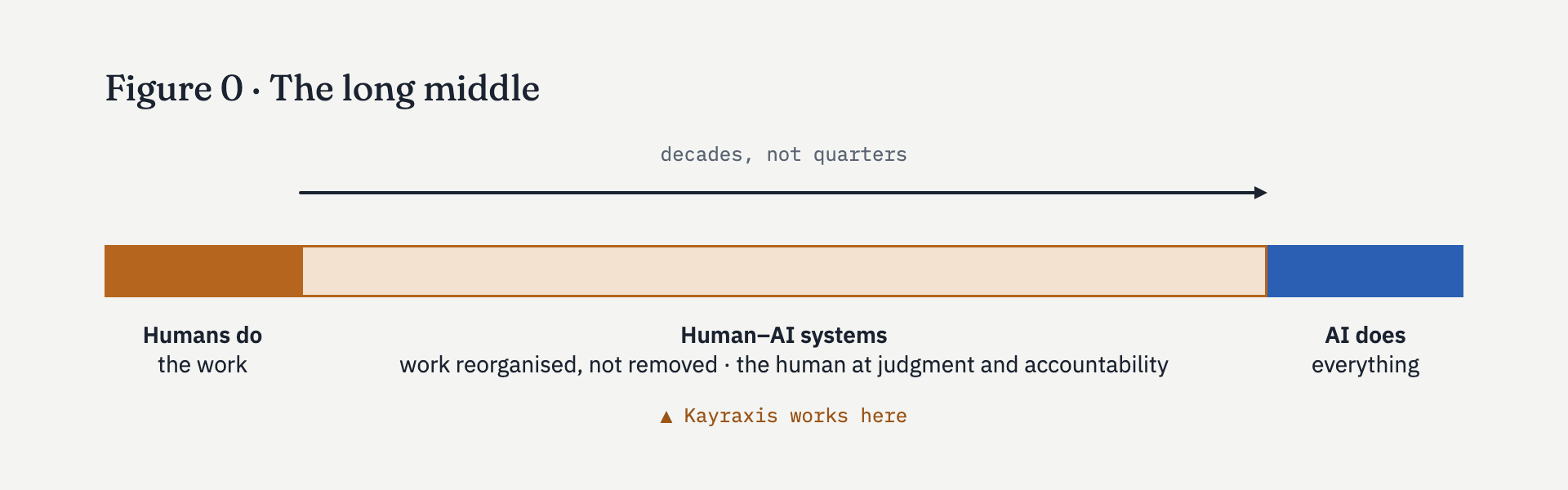
Between "humans do the work" and "AI does everything" sits a long period of Human–AI systems — the long middle. In it, work is not removed but reorganised. Take a lawyer writing an opinion letter. Her value comes from chaining functions together: understanding the matter, finding the cases, forming the opinion, writing the letter. AI will take some of those functions and change the others, and her role will shift toward judgment and responsibility for the final outcome. Every new tool in history brought new forms of cooperation and social organisation with it. This one will too, but only if we design these systems deliberately, with the human placed where judgment and accountability matter most.
The question is not only how people find meaning after work. It is how we redesign work so that meaning survives the transition.
To support humans through this transition with Human–AI systems that perform the functions that produce industrial value — cheaply enough that paying for the agents and the humans returns far more than it costs, and designed so that human meaning and self-knowledge survive.
- Every job is a chain of functions — understanding, finding, deciding, acting — and its value lives in the chain, not in any single link.
- The level of automation is set per function, not per job, and re-set as the frontier moves.
- Every Human–AI system runs under disturbances: on the machine (hallucination, drift), on the human (fatigue, automation bias), and on both (the de-skilling loop).
- Each disturbance needs a catch, and every catch is a kept, practised, paid human function.
- A system passes the Kayraxis test only when industrial utility and surviving meaning hold at the same time.