
At Kayraxis, we research and develop methods, computational tools and Human–AI systems to explore the affordances and the mythology of AI, and to redesign work for humans so that meaning and self-knowledge survive the transition.
Affordance is what the tool actually lets a person do; mythology is what people believe it does. Both have to be mapped, because a system is designed against the first and adopted against the second. The 58% hallucination rate is an affordance; the belief that the model "knows the law" is mythology; automation bias is what happens when the second is allowed to govern the first.
To support humans through this transition with Human–AI systems that perform the functions that produce industrial value — cheaply enough that paying for the agents and the humans returns far more than it costs, and designed so that human meaning and self-knowledge survive.
Kayraxis is a research-and-development loop, and each arm carries one half of it. The operational detail — the method, the trial protocol, the toolchain, the systems — lives on the divisions' own sites.
Research on all three layers of the mission — the methods for redesigning industrial work, the computational tools, and the Human–AI systems they combine into — with the measurement protocols, the field trials and their falsifiers, the open problems, and the people.
The industrial half: the toolchain — agents, a neuro-symbolic loop harness, a semantic context knowledge graph, long-term memory, a regulatory compliance service — and the vertical AI-native systems built on it, starting with Mergen AI.
A Human–AI system passes when two conditions hold at the same time.
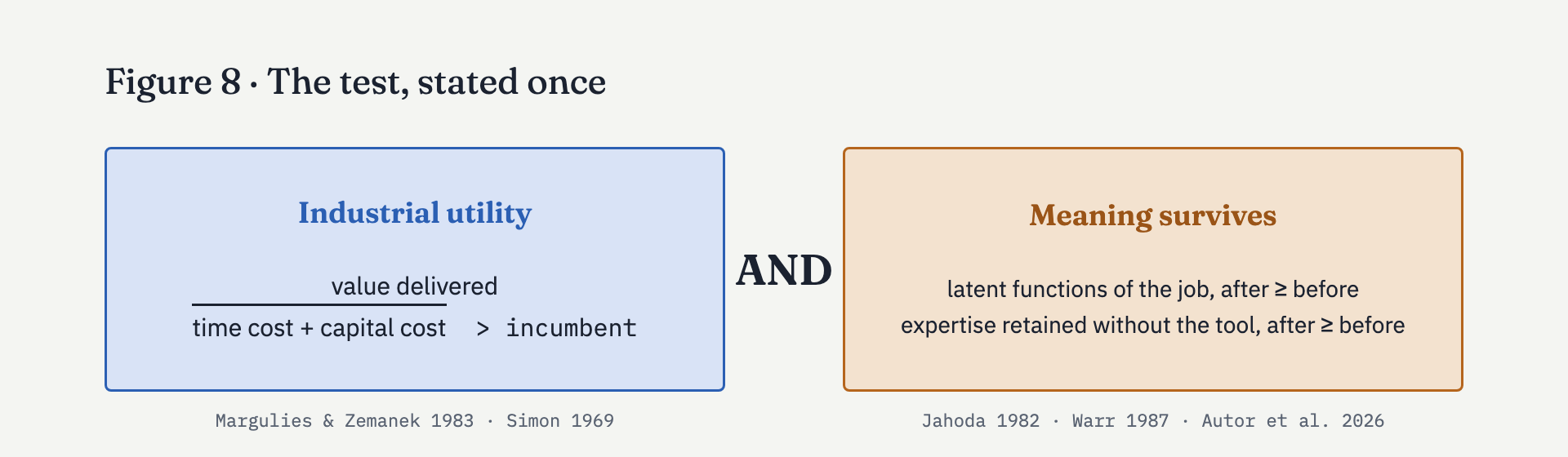
We know who went before us. Margulies and Zemanek wrote in 1983 that man's role in man–machine systems was the question; Bibby and his colleagues said in 1975 that it had to be designed in from the start; the IFAC committee on the social effects of automation spent a decade collecting cases where it was. Licklider and Engelbart described the partnership; Bainbridge described how it fails; Dekker and Woods described why substitution is the wrong model; Acemoglu and Restrepo showed the direction is a choice; and the field trials of the last three years have begun to show, in standard deviations, what the choice costs and what it returns. Danaher, Weeks and Susskind argue that the right answer is to stop working. We have read them carefully and we think they are wrong, for the reasons Jahoda measured and Arendt foresaw.
The toolmaking animal has met every obstacle nature put in front of it by making a tool, and then by reorganising its society around the tool. This tool reaches the functions nearest to judgment, and that is new. The response is not. We dissect reality into practical, utilitarian, industrial, digestible bits: the work into its functions, each function into what the machine can hold and what the human must, each system into the two sides of the test. We compute the allocation, build the system, measure, and publish. That is the voyage of self-understanding, and it is how the toolmaking animal will once more triumph over nature. It is the same voyage the species has been on since the first struck flint. It does not end with this tool. It continues through it.
Here is the version of 2036 we are working toward, stated plainly enough to be judged. The lawyer still signs the letter, and the letter costs a fraction of what it does today. The junior still becomes a senior, because the path ran through kept, practised verification instead of around it. The firm's scorecard shows output per cost and Jahoda's five functions on the same page, and neither line went down. Nobody was paid to pretend the machine wasn't there, and nobody was paid to disappear. If we get this right, the people living through the long middle will not remember it as a holding pattern before the end of work. They will remember it as work — theirs.
Treat this manifesto as a starting prompt rather than a finished position. We are looking for the firms willing to run these trials with us, the researchers who want to instrument them, and the critics who can find the flaw in the test. The sources are open, the numbers are stated so they can be wrong, and the argument is falsifiable on purpose.