If you read nothing elseEvery tool in history forced new forms of cooperation around itself; the only open question about this one is whether its reorganisation is designed or merely suffered. From the lineage, the psychology and the trials, five rules follow: allocate by function, keep judgment and the signature human, keep the human practised, count the latent functions, and prove utility on both sides of cost.
Confidence: the lowest in the manifesto. The rules are bets — and rule five is the one the market gets to grade.
Through the ceaseless effort to make work better and more effective, humans have developed not only new means of production but new forms of cooperation and social organisation to accompany them. Engels saw labour produce cooperation and then speech. Gille saw every coherent technical system force the society around it to reorganise, with crisis whenever the society lagged.
This tool will do the same. What is undecided is whether the reorganisation is designed or merely suffered. Simondon's diagnosis still holds: alienation does not come from machines but from a culture that does not understand them, and the cure is technical culture rather than refusal. Engelbart, in 1962, described augmentation not as a device but as a system of tools, methods, organisation and training improved together. Licklider, two years before, drew the line that still holds: instructions to computers specify courses; instructions to humans specify goals.
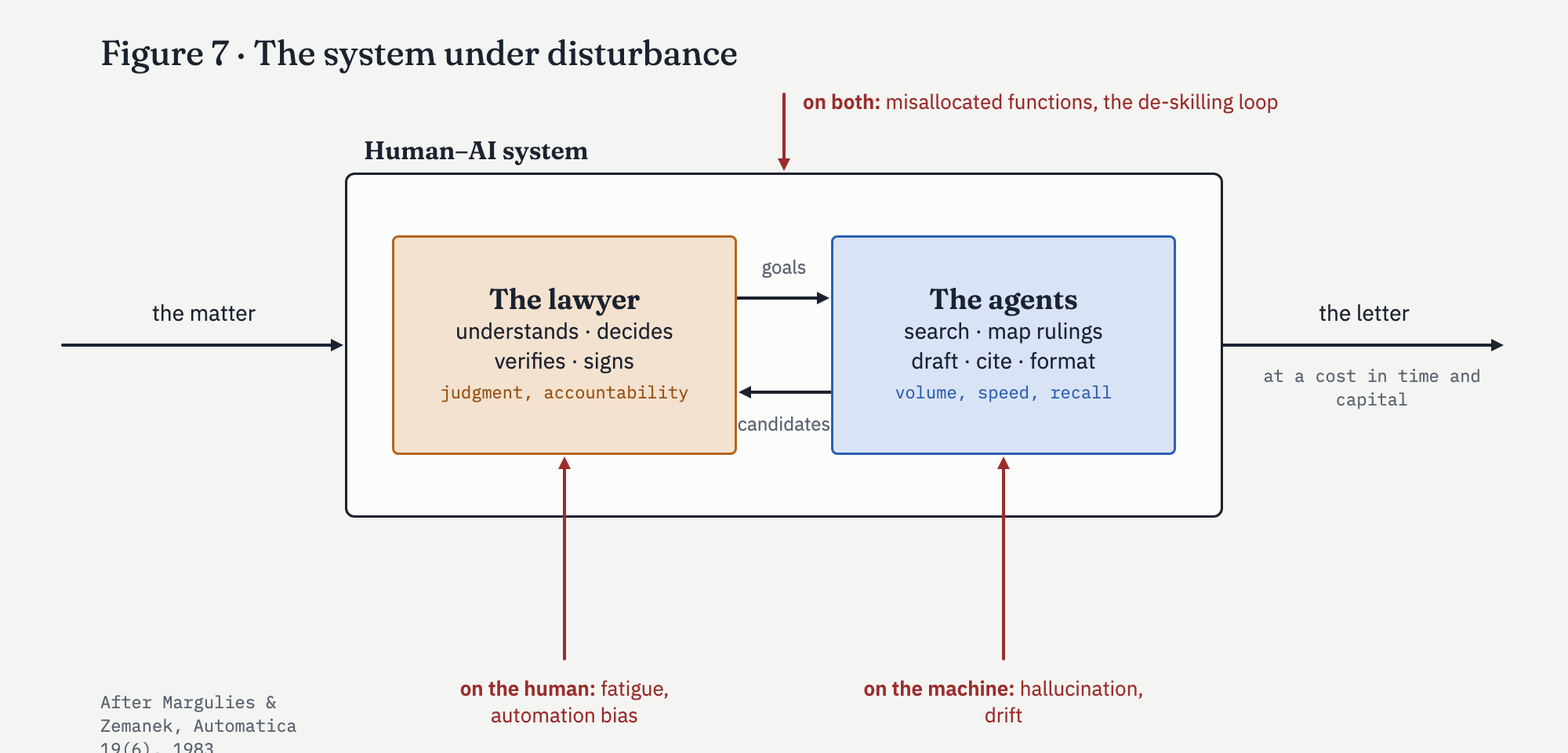
So we return to Margulies and Zemanek's definition and draw it for the lawyer. A Human–AI system takes a matter in, delivers a letter out at a cost in time and capital, and does so under disturbances that act on the human, on the machine, and on both together. The design of the system is the design of where each disturbance is caught.
Figure 7.Margulies and Zemanek's definition drawn for one job. Each disturbance has a place in the system where it must be caught, and each catch is a function someone has to keep: the lawyer verifies what the agents found; the agents never carry the signature; and the allocation itself is reviewed as the frontier moves.
The rules we derive
From the lineage, the psychology, the systems engineering and the field trials, five rules follow. They are the manifesto's operational content.
Allocate by function, not by job. Set the level of automation separately for acquiring, analysing, deciding and acting, as Parasuraman, Sheridan and Wickens prescribe, and re-set it as the frontier moves.
The human keeps judgment and the signature. Decision selection and accountability stay human by design, not by accident of what the model cannot yet do. The agents never carry the name on the letter.
Keep the human practised on what they must judge. Break Bainbridge's loop deliberately: verification is a kept, measured, paid function, and the system is built so that juniors still travel the path to expertise that Autor's trial showed the tool alone does not provide.
Count the latent functions.Jahoda's five and Warr's nine are measured before and after, alongside output per hour. A system that raises output and strips the job of shared purpose, status or skill use has failed the test.
Prove industrial utility on both sides of cost. Time and capital, measured against the incumbent, and repriced where the billable hour would otherwise swallow the gain. When value so far outruns cost, adoption makes itself.