
Confidence: the trial results are solid. My allocation of levels per function is a first guess — the whole point of the method is that it gets re-solved.
Consider the lawyer. She bills $900, at $250 an hour, for an opinion letter on an everyday matter: a dispute between a condo owner and the condo corporation. To deliver that $900 of value she must understand the matter, find the relevant cases, map the rulings and form an opinion, and write the letter.
The $900 is not paid for any one of these steps. It is paid for their combination. Each is a function, and value appears only when the functions are chained into a single, delivered outcome. That is Leroi-Gourhan's chaîne opératoire in a law office, and it is the Susskinds' decomposition of professional work into tasks, and it is the unit on which every decision about AI in knowledge work has to be made.
I see Human–AI systems through an industrialist's eyes rather than an inventor's. A Human–AI system has to deliver the same output more cheaply than the alternative already in wide use, and cost has two sides, time and capital, that must both be reasonable at once. No one pays a dollar to receive ten cents, and no one waits a week for what they needed in a day. Electricity was adopted at scale because the value it delivered so far outran its price that the choice made itself. So the test for a Human–AI system is this: can it perform the functions that produce the value, and do so cheaply enough that paying for the agents and the humans returns far more than it costs? And, this manifesto adds, can it do that while leaving the lawyer a job that is still hers?
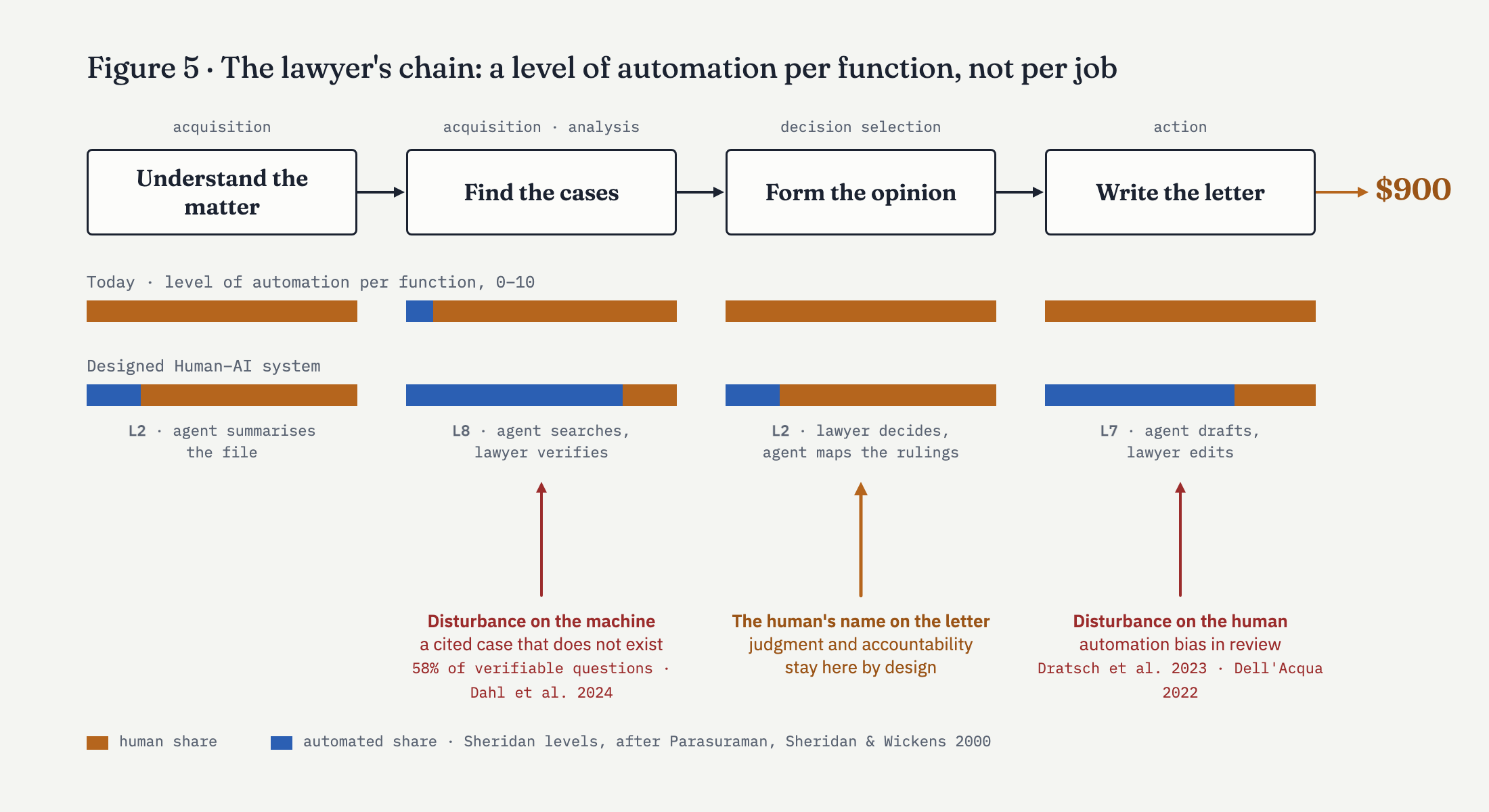
Three results from the last three years decide how to read the figure above. Dell'Acqua and colleagues gave 758 consultants GPT-4 and found a jagged frontier: inside the model's capability, people did 12% more tasks, 25% faster, at 40% higher quality; on a task just outside it, they were 19% more likely to be wrong, because they trusted the tool where it should not have been trusted. Two work patterns emerged, which they called centaurs, who divide the task, and cyborgs, who interleave. Vaccaro, Almaatouq and Malone's meta-analysis of 106 experiments is harder still: human–AI teams beat the better of the two alone only on creation tasks, not on decision tasks. Complementarity has to be designed. It does not come free.
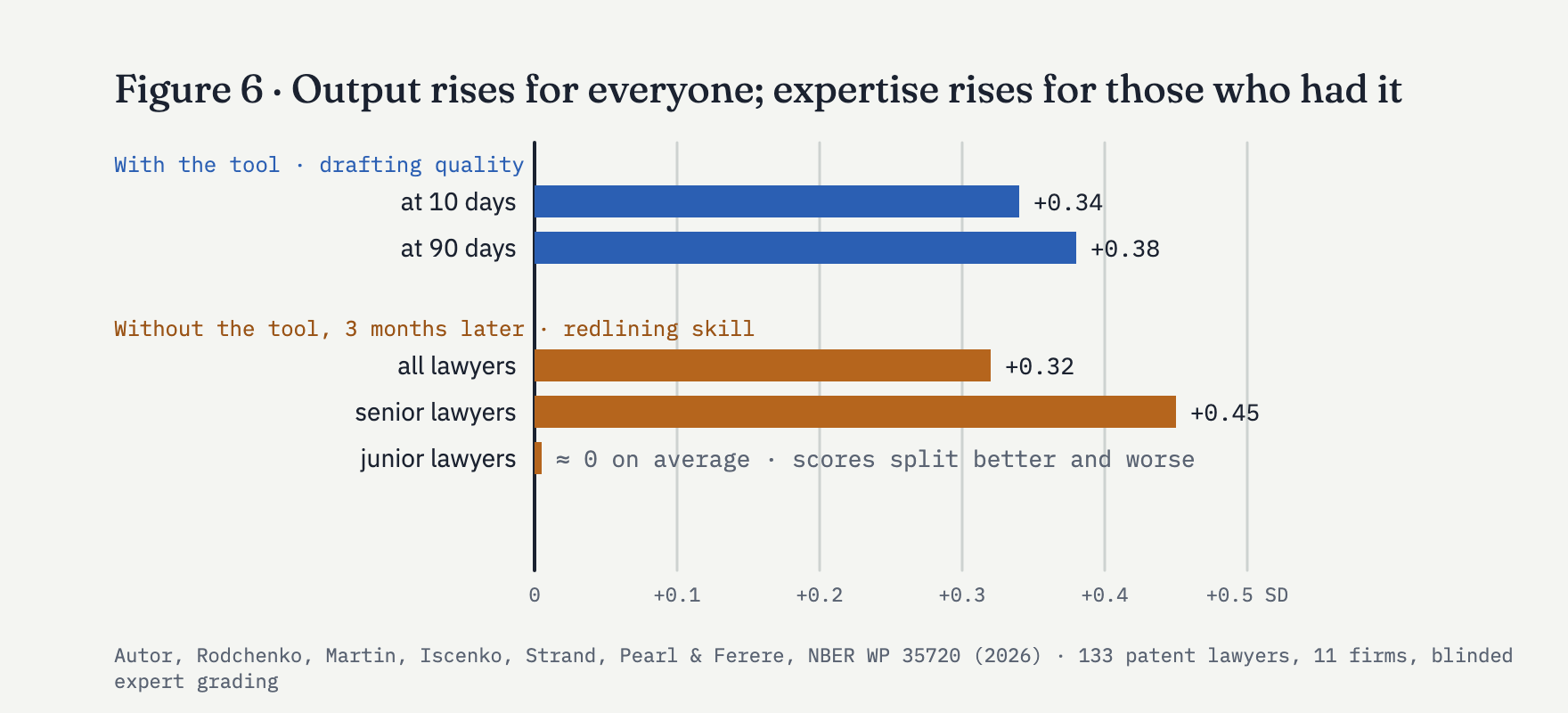
Then, in 2026, the first field trial with practising lawyers. Autor and colleagues gave 133 patent lawyers at eleven firms an AI drafting assistant for three months. Their drafts improved by a third of a standard deviation. Then the tool was taken away and everyone redlined a patent cold. Treated lawyers were still a third of a standard deviation better, but that retained gain belonged entirely to the senior lawyers. The juniors showed no average gain; their scores split into better and worse. The authors' conclusion is the one Bainbridge predicted in 1983: foundational expertise may be the prerequisite for turning AI use into durable skill.
Add the base rates. Dahl, Magesh, Suzgun and Ho found that general models hallucinated on 58% of verifiable questions about federal cases and could not tell when they were doing it; even retrieval-backed legal research products failed on 17–33% of answers. The cited case that does not exist is not a hypothetical disturbance. It is the modal one. The "find the cases" function can be automated to a high level only if the "verify the cases" function is kept, practised, and paid for.
And then the firm's problem, which the public debate forgets. Under the billable hour, a faster lawyer earns the firm less per matter. Clio estimates up to $27,000 per lawyer per year of billable revenue at risk if efficiencies are not repriced; Rapoport and Tiano argue the associate pyramid, which runs on junior hours AI now does, has to be replaced by pricing the human-insight work. Perlin disagrees. His CHRGE equation, compensation equals hours times rate minus granted reductions minus expenses, shows that hours can fall while rates rise, write-downs shrink and expenses drop, so hourly billing may survive and even thrive. We do not need to settle that dispute. Both sides agree on the thing that matters to us: the gain is real only if the firm redesigns how it prices and staffs the chain, and not just which links it automates.
These are guesses, stated plainly so they can be wrong. The designed system for the opinion letter should deliver it in a day instead of a week, at a third of today's cost, with every citation passing a kept, practised human verification — and with the lawyer's latent-function scores, measured before and after, no lower than they were. The dream scenario is Autor's result inverted: juniors who work inside the system redline better cold after three months, because verification was built as their path to expertise instead of being removed from it.
And what would prove us wrong: if juniors inside a system built on rule three still show no retained gain; if kept verification cannot be priced into the letter without losing the cost case; or if Vaccaro's finding — that human–AI teams lose to the better partner on decision tasks — survives even allocation per function. Any one of these breaks the manifesto's operational content. If we find them, we will publish them.