Confidence: high on the findings, which have held for fifty years; lower on how fast the frontier moves them.
Technological systems of every kind, whatever their complexity, may form part of a human–machine system: industrial plants, vehicles, computers, prostheses. The purpose of any such system is the same: to deliver a work function, product or service at reasonable cost, under the disturbances that act on the human, on the machine, and on both together.
That sentence is Margulies and Zemanek's, from a 1983 paper in Automatica called "Man's role in man–machine systems," and our opening chapter is a paraphrase of theirs. They in turn were restating a 1975 paper from IFAC's committee on the social effects of automation: even the most automated systems, electric power networks for instance, need people for supervision, adjustment, maintenance and improvement, so the automated system is still a man–machine system, and human factors have to be designed in from the start. What they called "man's role" we call the long middle. The field has been working in it for fifty years. We are not inventors here; we are heirs.
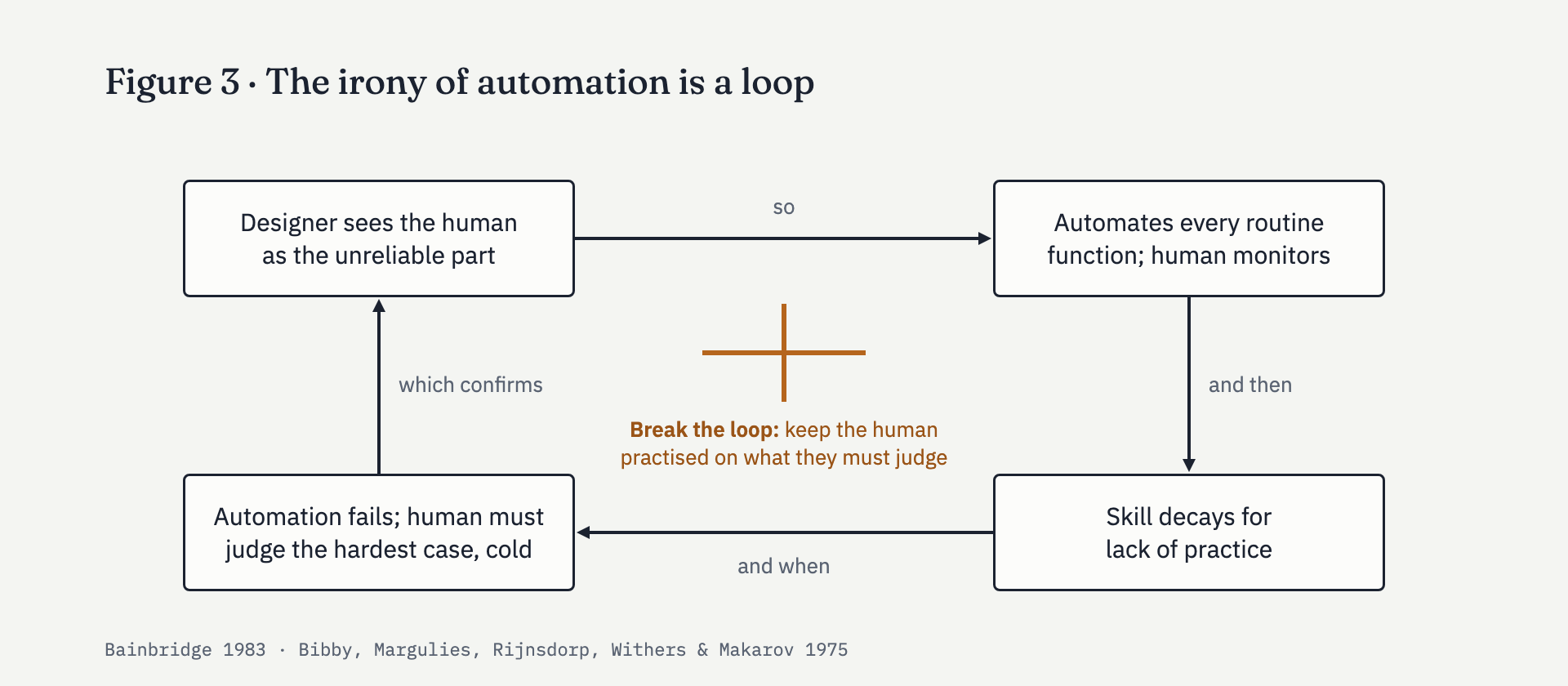
The same volume carried Bainbridge's "Ironies of Automation," which is the most important warning in the literature and the one most often ignored. The designer who regards the operator as unreliable automates everything that can be automated, and leaves the operator the tasks that could not be, now with less practice and more monitoring. The more advanced the system, the more crucial the human's contribution and the less prepared the human is to make it.
I have been building automation professionally since 2015, at Toronto startups and then leading generative AI development at Oracle, and I have never once seen this loop break itself. Somebody always has to break it on purpose, and it is never the person who was paid to close it.
Between 1975 and now the field settled three things we rely on. First, Fitts's 1951 list of what people do better and what machines do better, the origin of asking "which functions should the machine take?", does not work as a method. Chapanis said so in 1965 and Dekker and Woods proved it in 2002: automation does not substitute for human work, it transforms it, creating new tasks of coordination, so the useful question is how human and machine cooperate. Work is reorganised, not removed. That is a finding, not a slogan.
Second, "automation" is not one thing. Sheridan and Verplank drew ten levels between full manual control and full autonomy, and Parasuraman, Sheridan and Wickens in 2000 showed that the level must be set separately for four kinds of function: acquiring information, analysing it, selecting a decision, and carrying it out. A system can be fully automated in acquisition and barely automated in decision. That is the template we apply to the lawyer in Chapter IV.
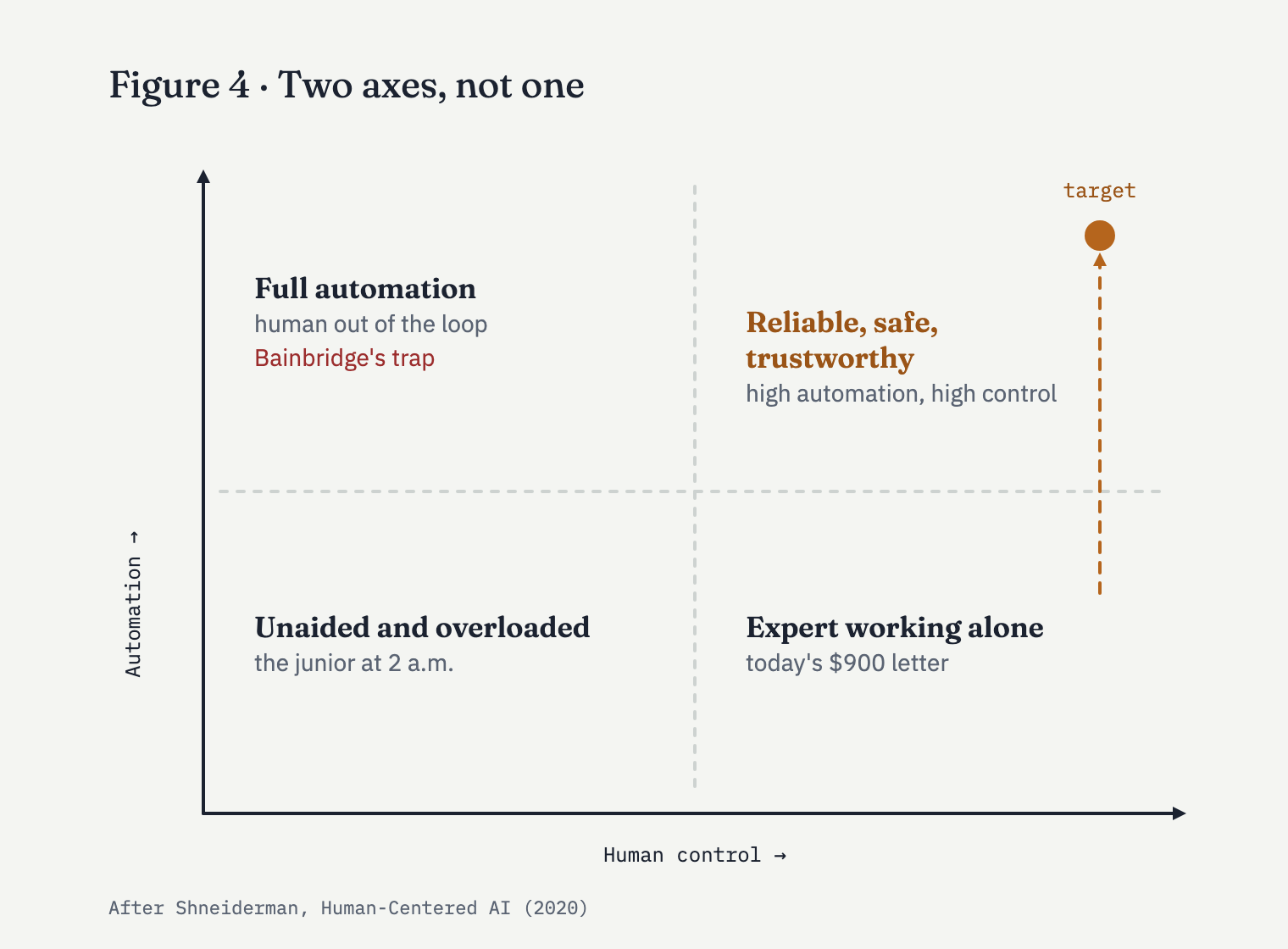
Third, the direction is a choice. Acemoglu and Restrepo showed that AI is a platform that can be built toward automation or toward augmentation, with very different consequences for labour demand, and that the current drift is toward "the wrong kind of AI." Brynjolfsson called the imitation of humans the Turing trap: it concentrates gains, while augmenting humans spreads them. Shneiderman replaced the one-dimensional ladder from human to machine with two axes, and set the target where both human control and automation are high.