
Confidence: the highest in the manifesto. This chapter is measured psychology, not my guesses — the one result here I would least expect to be overturned.
In 1958, with automation on the horizon, Arendt warned of a society of labourers without labour: a society that had made labour the only activity it still recognised as meaningful, about to be freed from it. Surely, she wrote, nothing could be worse.
I take that warning as my starting point, and I take it as a prediction that can be tested. It has been. Marie Jahoda's work on the unemployed, from the Marienthal study in the 1930s to her 1982 synthesis, separated the manifest function of employment, which is income, from five latent functions that come with it whether or not anyone intends them. Employment imposes a time structure on the day. It enforces regular shared experience outside the family. It links the individual to collective purposes. It assigns status and identity. It requires activity. The unemployed lose all six, and the evidence says it is the loss of the five latent functions, not the first, that does most of the damage.
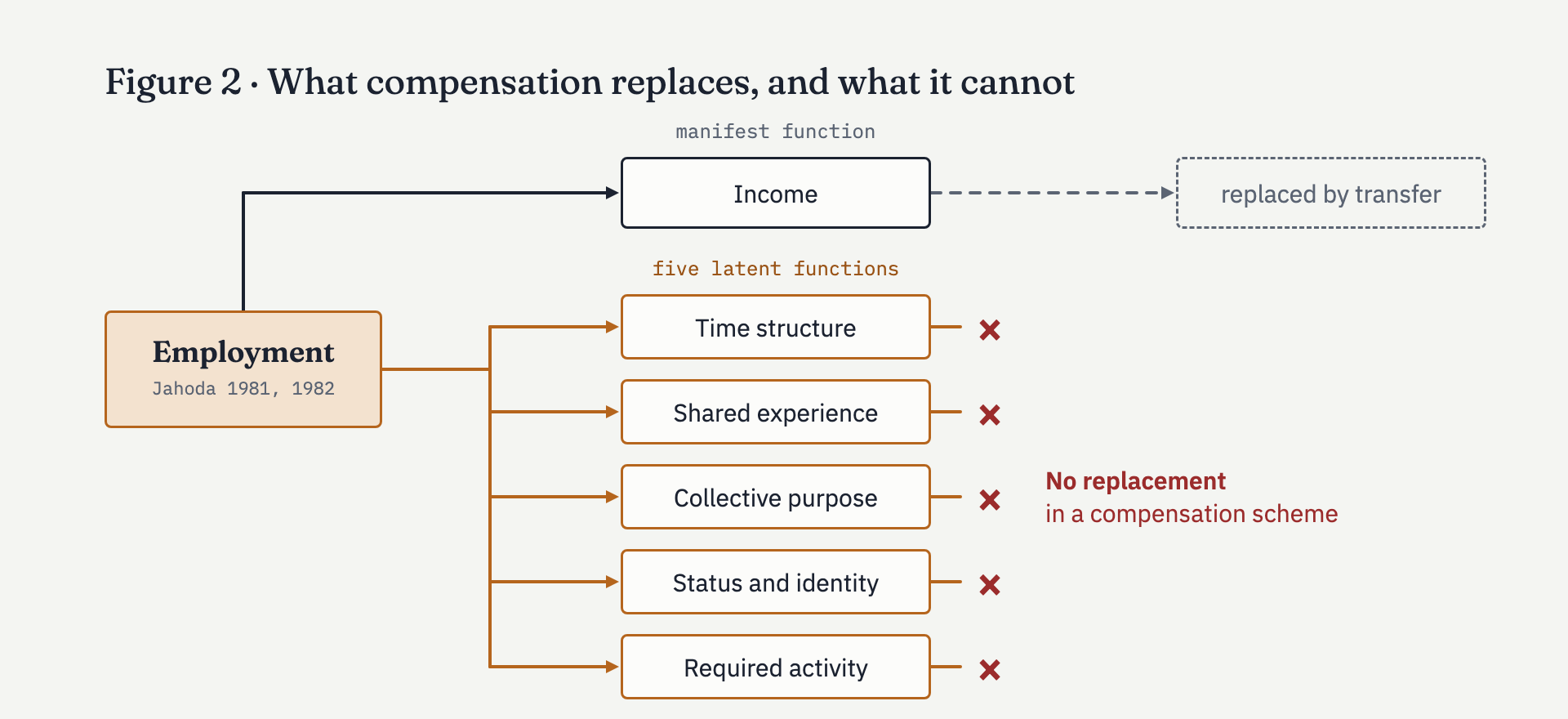
Warr's "vitamin model" names nine features of any environment, in a job or out of one, that govern mental health: opportunity for control, for skill use, externally generated goals, variety, clarity, money, physical security, interpersonal contact and a valued social position. Some have a ceiling; some turn toxic in excess. We use it as a checklist in Chapter VI, because it lets us ask what a Human–AI system removes from a job, not only what it adds to its output.
The philosophers agree with the psychologists. Schwartz argued in 1982 that a just society owes its members work that exercises autonomy and judgment, not only income; Bowie put the claim in Kantian terms; Yeoman called meaningful work a fundamental human need. Gheaus and Herzog listed the goods of work other than money, and the list is short enough to carry: attaining excellence, making a social contribution, experiencing community, being recognised. Danaher and Nyholm then described exactly what automation threatens: when a machine does the hard part, the human's claim to the achievement shrinks, because achievement needs effort, voluntariness and a real causal contribution, and automation thins all three.
So the stakes of the transition are not a matter of what to pay people. They are a matter of which functions of work, manifest and latent, survive the redesign.