
Confidence: high. This chapter is intellectual history — the sources are up to two centuries old and have survived their critics.
The question of how humans relate to machines is as old as humanity itself. It begins at the moment when the deliberate making of tools marked the passage from animal to the earliest ancestors of human beings.
On Easter Sunday 1778, Boswell told Johnson he thought Benjamin Franklin's definition of man a good one: "a tool-making animal." Johnson objected at once. Many a man never made a tool, he said, and a man without arms could not make one. The whole argument of this manifesto is contained in that exchange. Boswell is right about the species; Johnson is right about the individual. Franklin's phrase describes humanity's relation to nature, not the contents of any one person's hands. No product exists that was made wholly without a person, and no person's standing in the world rests only on what their own hands produced. I hold both.
Engels made the species claim precise a century later. Labour, he argued, created the human: upright gait freed the hand, the hand shaped by labour became both the organ and the product of labour, labour forced cooperation, cooperation produced speech, and labour and speech together enlarged the brain. Washburn restated the same sequence in the language of modern evolutionary anthropology in 1960: the tools came first, and the body followed. Oakley, at the British Museum, used tool-making as the line in the fossil record where the human begins.
Bergson gave the idea its name. If we defined our species by what history and prehistory constantly show, he wrote, we would call it not Homo sapiens but Homo faber: intelligence is first of all the faculty of making tools, and tools to make tools. Kapp had already noticed, in 1877, that every tool is a projected organ. The hammer extends the fist, the lens the eye, the telegraph the nerves. Humans learn what they are by reading themselves back from what they make.
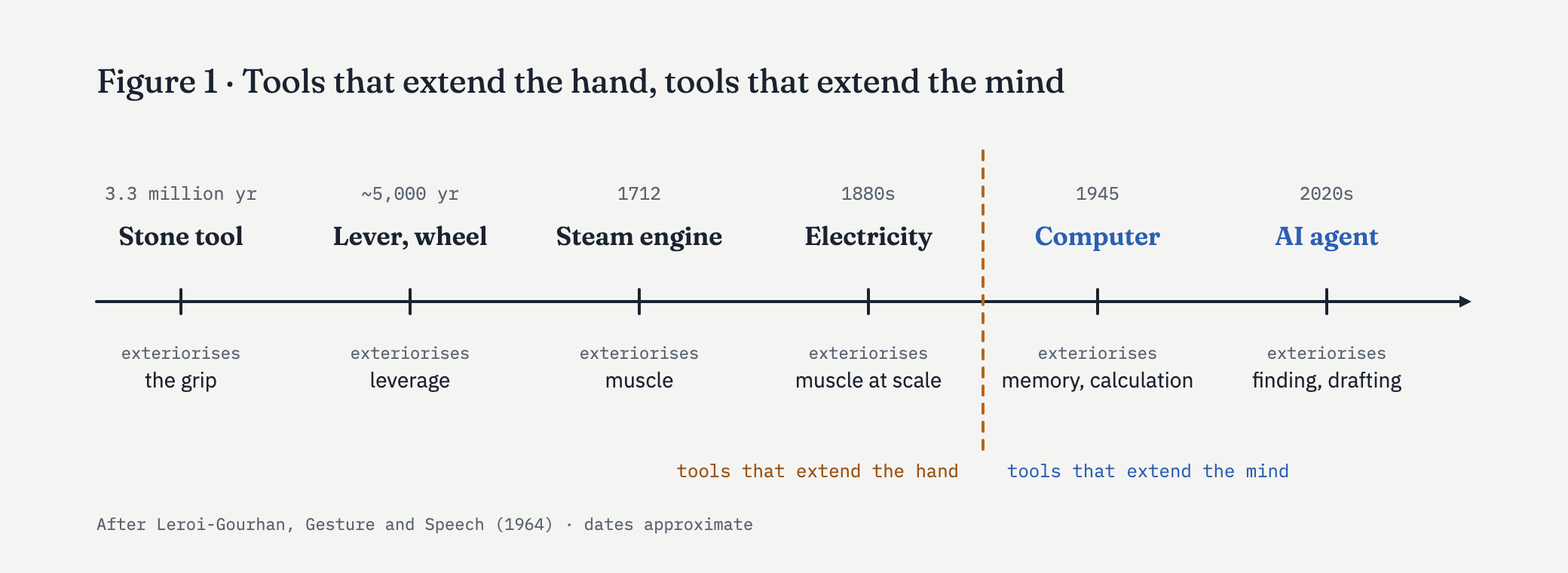
Leroi-Gourhan also gave us the concept we will use for the rest of this manifesto: the chaîne opératoire, the operational sequence of gestures by which a tool is made. A stone axe is a chain of strikes in a learned order. An opinion letter is a chain of cognitive gestures in a learned order. In both cases the value is in the chain, not in any single link, and in both cases the chain is what a new tool reorganises.
Arendt drew the distinction that lets us say "human category" without sliding into economics. The active life has three parts: labour, the cyclical struggle with necessity; work, the making of a durable world; and action, speech and deed among equals. Modernity glorified labour and collapsed the other two into it. When we say work must survive, we mean all three, and we mean especially the second: the part where a person makes something that outlasts the making. Sennett and Crawford, writing fifty years later about craft, describe the same thing from the inside. Doing a job well for its own sake is how skill forms, and forming skill is how a person comes to understand what they are.
I knew this long before I could cite anyone for it. My grandfather taught me chess when I was five; the tournaments, and later the programming olympiads, taught me less about chess and code than about myself. Skill formed under practice is how I came to know what I am — which is exactly the thing, Chapter IV will show, that a badly designed system quietly takes from its juniors.
Stiegler pushed the argument to its limit: there is no human before technics and no technics without the human; the two invent each other. He also named the danger. Technics is exteriorised memory, and exteriorised memory can be lost by the one who exteriorised it. That is the risk the next chapter is about.